A bill of quantities (BoQ) is the backbone of a construction tender. It sets out, item by item, the measured quantities of work required to build a project, so that every contractor prices exactly the same scope on exactly the same basis. In South Africa the standard framework for that document comes from the Association of South African Quantity Surveyors (ASAQS). This guide explains what a BoQ is, how it's put together, and what "ASAQS" actually means in practice.
What is a bill of quantities?
A BoQ translates drawings and specifications into a structured, priceable list. Rather than asking contractors to interpret the drawings and guess quantities themselves, the quantity surveyor measures the work once, and every tenderer prices the same measured quantities. That makes tenders directly comparable and gives the client a fair, transparent basis for award.
Once priced, the same document does a lot of work through the project life cycle:
- It's the basis for comparing tenders on a like-for-like basis.
- It supports interim valuations and payment as the work proceeds.
- It provides rates for valuing variations when the scope changes.
- It becomes a cost record for future estimating.
What's in a BoQ
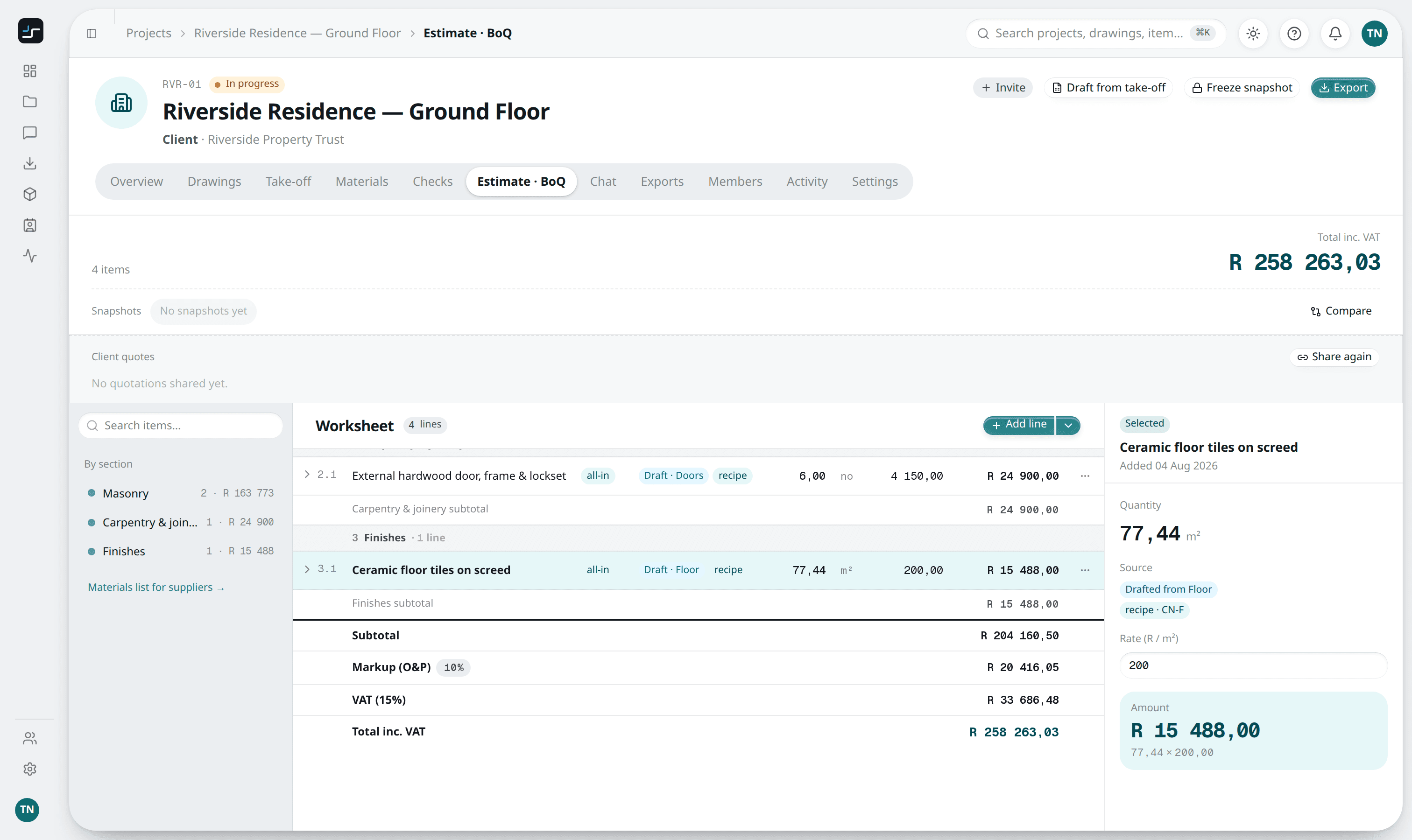
A bill is organised into sections, and each section into items. Most bills open with preliminaries— the project-wide costs that aren't tied to a single trade (site establishment, supervision, plant, insurances) — followed by the measured work grouped by trade or element: earthworks, concrete, masonry, and so on.
Every measured item carries the same handful of columns:
- Description — what the item is, to the measurement standard's wording.
- Unit — how it's measured: m, m², m³, kg or number (No).
- Quantity — the measured amount, straight from the take-off.
- Rate — the price per unit, entered by the tenderer.
- Amount — quantity × rate.
Item amounts total to a section total; section totals carry to a summary; and the summary, plus preliminaries and any provisional or prime-cost sums, gives the tender total.
The ASAQS standard
"ASAQS" on a bill signals that the work has been measured and described to the South African standard system of measurement, using standard item descriptions and a recognised bill structure. The value of that standardisation is consistency: a contractor reading an ASAQS bill knows precisely what each item includes and how it was measured, so the rate they put against it means the same thing to everyone.
How a priced BoQ comes together
Traditionally, producing a bill was a multi-stage effort:
- Taking-off — measuring quantities from the drawings.
- Squaring — calculating each measurement into a quantity.
- Abstracting — collecting like quantities together.
- Billing — writing the descriptions and drafting the final document.
Modern take-off software compresses those stages. When quantities land on named conditions, the squaring and abstracting happen automatically — identical items collect themselves, and the descriptions and units come from the condition. The result is that a priced BoQ falls out of the take-off, rather than being re-built by hand afterwards. (For the measuring half of that, see How to do a take-off from a PDF drawing.)
Exporting and sharing
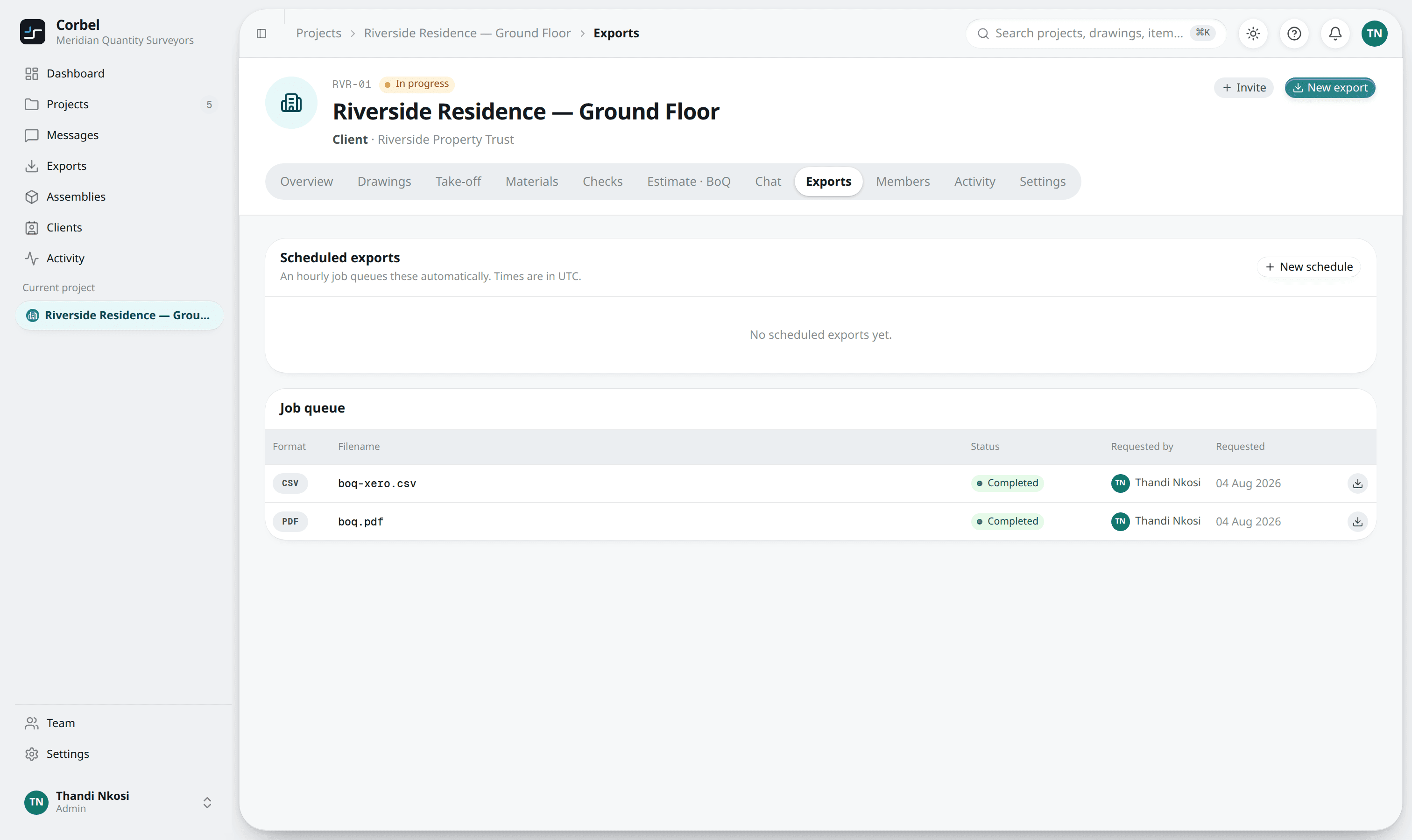
A finished bill has to leave the tool. A BoQ typically exports to Excel for pricing and adjustment, to PDF for issuing, and to CSV for importing into other systems. Because the document is built on live quantities and rates, re-exporting after a change is instant — no manual re-totalling.